 Add to Chrome
 Add to Firefox
 Add to Edge
Power Stabilization for AI Training Datacenters
Aug 21, 2025
Large Artificial Intelligence (AI) training workloads spanning several tens of thousands of GPUs present unique power management challenges. These arise due to the high variability in power consumption during the training. Given the synchronous nature of these jobs, during every iteration there is a computation-heavy phase, where each GPU works on the local data, and a communication-heavy phase where all the GPUs synchronize on the data. Because compute-heavy phases require much more power than communication phases, large power swings occur. The amplitude of these power swings is ever increasing with the increase in the size of training jobs. An even bigger challenge arises from the frequency spectrum of these power swings which, if harmonized with critical frequencies of utilities, can cause physical damage to the power grid infrastructure. Therefore, to continue scaling AI training workloads safely, we need to stabilize the power of such workloads. This paper introduces the challenge with production data and explores innovative solutions across the stack: software, GPU hardware, and datacenter infrastructure. We present the pros and cons of each of these approaches and finally present a multi-pronged approach to solving the challenge. The proposed solutions are rigorously tested using a combination of real hardware and Microsoft's in-house cloud power simulator, providing critical insights into the efficacy of these interventions under real-world conditions.

GPT-4o System Card
Oct 25, 2024GPT-4o is an autoregressive omni model that accepts as input any combination of text, audio, image, and video, and generates any combination of text, audio, and image outputs. It's trained end-to-end across text, vision, and audio, meaning all inputs and outputs are processed by the same neural network. GPT-4o can respond to audio inputs in as little as 232 milliseconds, with an average of 320 milliseconds, which is similar to human response time in conversation. It matches GPT-4 Turbo performance on text in English and code, with significant improvement on text in non-English languages, while also being much faster and 50\% cheaper in the API. GPT-4o is especially better at vision and audio understanding compared to existing models. In line with our commitment to building AI safely and consistent with our voluntary commitments to the White House, we are sharing the GPT-4o System Card, which includes our Preparedness Framework evaluations. In this System Card, we provide a detailed look at GPT-4o's capabilities, limitations, and safety evaluations across multiple categories, focusing on speech-to-speech while also evaluating text and image capabilities, and measures we've implemented to ensure the model is safe and aligned. We also include third-party assessments on dangerous capabilities, as well as discussion of potential societal impacts of GPT-4o's text and vision capabilities.
Evaluating Large Language Models Trained on Code
Jul 14, 2021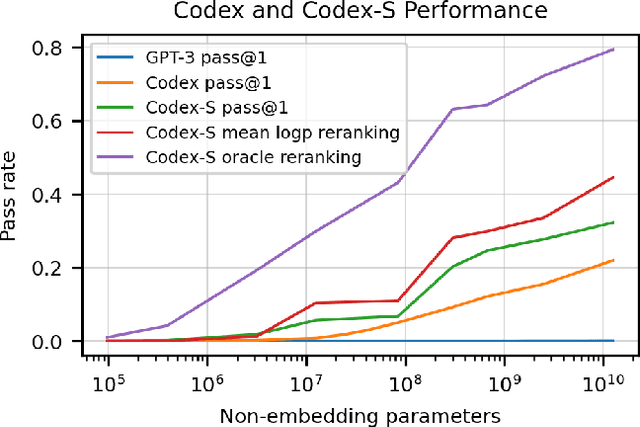
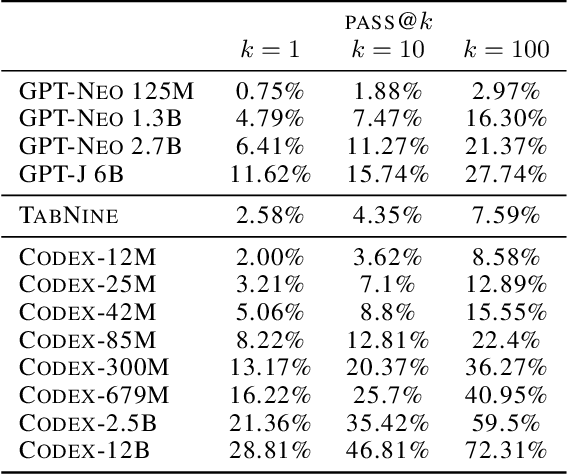
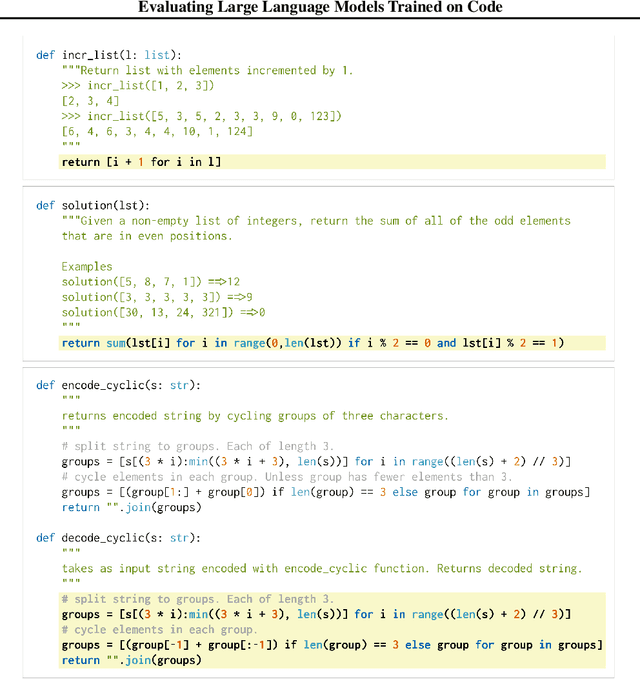
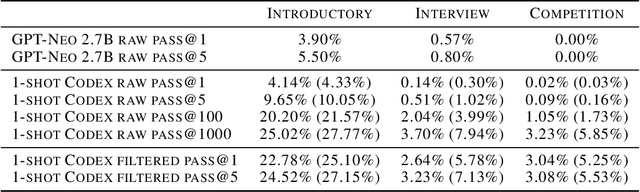
We introduce Codex, a GPT language model fine-tuned on publicly available code from GitHub, and study its Python code-writing capabilities. A distinct production version of Codex powers GitHub Copilot. On HumanEval, a new evaluation set we release to measure functional correctness for synthesizing programs from docstrings, our model solves 28.8% of the problems, while GPT-3 solves 0% and GPT-J solves 11.4%. Furthermore, we find that repeated sampling from the model is a surprisingly effective strategy for producing working solutions to difficult prompts. Using this method, we solve 70.2% of our problems with 100 samples per problem. Careful investigation of our model reveals its limitations, including difficulty with docstrings describing long chains of operations and with binding operations to variables. Finally, we discuss the potential broader impacts of deploying powerful code generation technologies, covering safety, security, and economics.
Dota 2 with Large Scale Deep Reinforcement Learning
Dec 13, 2019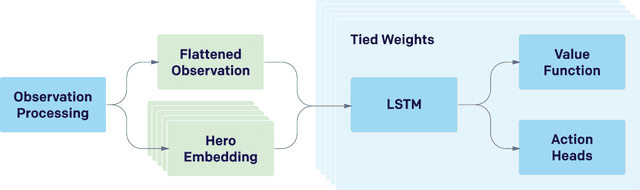
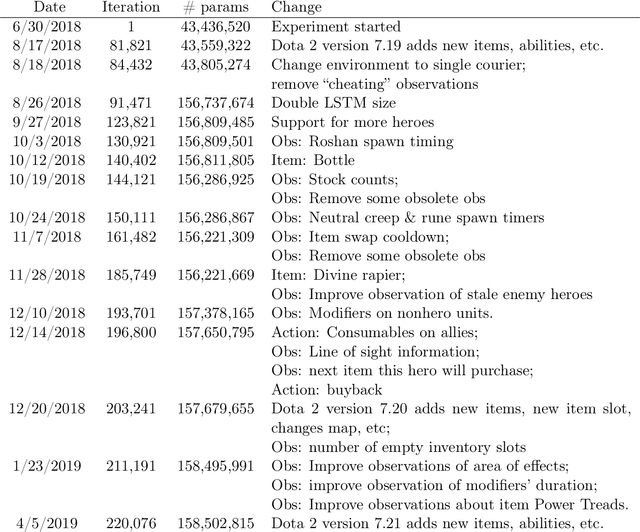
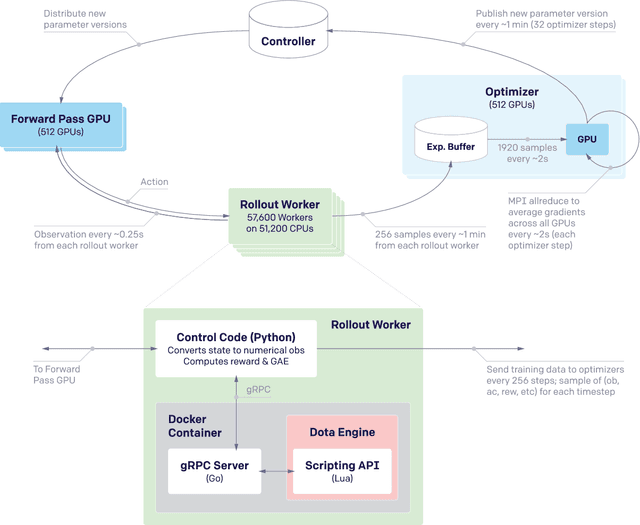
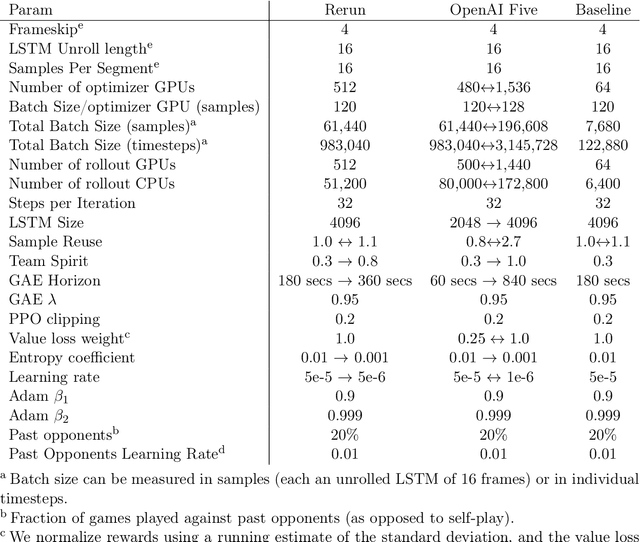
On April 13th, 2019, OpenAI Five became the first AI system to defeat the world champions at an esports game. The game of Dota 2 presents novel challenges for AI systems such as long time horizons, imperfect information, and complex, continuous state-action spaces, all challenges which will become increasingly central to more capable AI systems. OpenAI Five leveraged existing reinforcement learning techniques, scaled to learn from batches of approximately 2 million frames every 2 seconds. We developed a distributed training system and tools for continual training which allowed us to train OpenAI Five for 10 months. By defeating the Dota 2 world champion (Team OG), OpenAI Five demonstrates that self-play reinforcement learning can achieve superhuman performance on a difficult task.